

Do hot air fans have a remote - control range?
As a supplier of hot air fans, I often encounter various questions from customers. One of the frequently asked questions is whether hot air fans have a remote - control range. In this blog, I'll delve into this topic and provide you with a comprehensive understanding.
First, let's understand what a hot air fan is. A hot air fan is a device that generates and blows hot air. It is widely used in different scenarios, such as industrial processes for drying, heating, or shrinking materials, and in household settings for quick - warming up a room. With the advancement of technology, many hot air fans now come with remote - control functionality, which offers great convenience to users.
When it comes to the remote - control range of hot air fans, several factors come into play. The first and most significant factor is the type of remote - control technology used. There are mainly two types: infrared (IR) and radio - frequency (RF).
Infrared remote - control systems are commonly used in many consumer electronics, including some hot air fans. IR remotes work by emitting infrared light signals. The hot air fan has a receiver that can detect these signals and execute the corresponding commands. However, IR technology has some limitations. The range is typically limited because infrared light is a line - of - sight technology. This means that the remote must be pointed directly at the receiver on the hot air fan for it to work. Generally, the effective range of an IR - controlled hot air fan is around 3 - 5 meters. If there are obstacles between the remote and the receiver, such as furniture or people, the signal can be blocked, and the remote may not work properly.
On the other hand, radio - frequency (RF) remote - control systems offer a more flexible and extended range. RF remotes use radio waves to transmit signals. Unlike infrared, radio waves can penetrate through some obstacles, such as walls and furniture, to a certain extent. The range of an RF - controlled hot air fan can be much greater, often up to 10 - 20 meters or even more, depending on the specific design and power of the RF system. This makes RF - controlled hot air fans more convenient in larger spaces or when the user cannot have a direct line - of - sight to the fan.

Another factor that affects the remote - control range is the power of the remote and the sensitivity of the receiver on the hot air fan. A more powerful remote can send stronger signals, which can travel farther. Similarly, a more sensitive receiver can pick up weaker signals, thus increasing the overall range. Manufacturers often optimize these components to achieve the best possible remote - control performance.
The environment also plays a role in determining the remote - control range. For example, in an area with a lot of electromagnetic interference, such as near a large electrical appliance or in a factory with many machines, the signal strength of the remote - control system can be affected. This interference can disrupt the transmission of signals and reduce the effective range.
As a hot air fan supplier, we offer a variety of hot air fans with different remote - control capabilities. Our Conveyor Belt Electronic Hot Air Heat Gun is a great example. It is designed for industrial applications where precise control of hot air is required. With its advanced RF remote - control system, users can conveniently adjust the temperature and airspeed from a distance, improving work efficiency and safety.
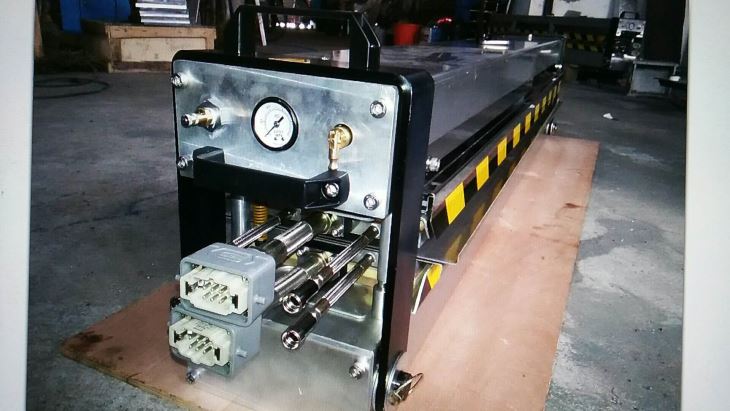
In addition to the heat gun, we also have Conveyor Belt Cutter and Conveyor Belt Water Cooling Splice Machine in our product line. These products are all designed with the latest technology to meet the diverse needs of our customers.
If you are in the market for a hot air fan or related products, it is crucial to consider the remote - control range according to your specific usage scenario. If you need to control the fan from a short distance and in an open space, an IR - controlled fan may be sufficient. However, if you require a longer - range and more flexible control, especially in a large or obstructed area, an RF - controlled fan is a better choice.
We understand that every customer has unique requirements. That's why we are committed to providing high - quality products with excellent remote - control performance. Our team of experts is always ready to assist you in selecting the most suitable product for your needs. Whether you are a small - scale business or a large industrial enterprise, we have the right solution for you.
If you are interested in our hot air fans or other related products, we encourage you to contact us for a detailed discussion. We can provide you with more information about the product features, specifications, and pricing. Our goal is to establish long - term partnerships with our customers by offering reliable products and excellent service.
In conclusion, hot air fans do have a remote - control range, which is determined by factors such as the type of remote - control technology, the power of the remote and the sensitivity of the receiver, and the environment. By understanding these factors, you can make an informed decision when purchasing a hot air fan.
References
- "Remote - Control Technology Basics" by Electronics World Magazine
- "Industrial Applications of Hot Air Fans" by Industrial Equipment Journal