

Conveyor belts are an integral part of numerous industries, facilitating the efficient movement of materials from one point to another. As a conveyor belt supplier, I've witnessed firsthand the diverse range of materials used in their construction, each tailored to specific applications and requirements. In this blog, I'll delve into the various materials that conveyor belts are made of, highlighting their unique properties and ideal use cases.
Rubber
Rubber is one of the most commonly used materials for conveyor belts due to its excellent flexibility, durability, and resistance to abrasion. It can be formulated to have different levels of hardness, depending on the intended application. For instance, softer rubber belts are suitable for handling delicate items, while harder rubber belts are better for heavy-duty applications.
Natural rubber, derived from the latex of rubber trees, offers high elasticity and resilience. It is often used in applications where shock absorption is crucial, such as in the mining and quarrying industries. Synthetic rubbers, on the other hand, are engineered to have specific properties, such as oil resistance, heat resistance, or chemical resistance. Neoprene, for example, is a synthetic rubber that is resistant to oil, ozone, and weathering, making it ideal for use in outdoor applications or in environments where exposure to chemicals is a concern.
Rubber conveyor belts can be reinforced with various materials, such as textile fabrics or steel cords, to enhance their strength and durability. Textile-reinforced belts are commonly used in light to medium-duty applications, while steel cord-reinforced belts are used in heavy-duty applications, such as in the transportation of bulk materials over long distances.
PVC (Polyvinyl Chloride)
PVC is a versatile plastic material that is widely used in the manufacturing of conveyor belts. It is known for its excellent chemical resistance, low cost, and ease of processing. PVC conveyor belts are commonly used in the food processing, packaging, and electronics industries, where cleanliness and hygiene are important.
PVC belts can be formulated to have different properties, such as anti-static, flame-retardant, or food-grade. Anti-static PVC belts are used in applications where static electricity can cause problems, such as in the electronics industry. Flame-retardant PVC belts are used in applications where fire safety is a concern, such as in the mining and transportation industries. Food-grade PVC belts are used in the food processing industry, where they must meet strict hygiene and safety standards.
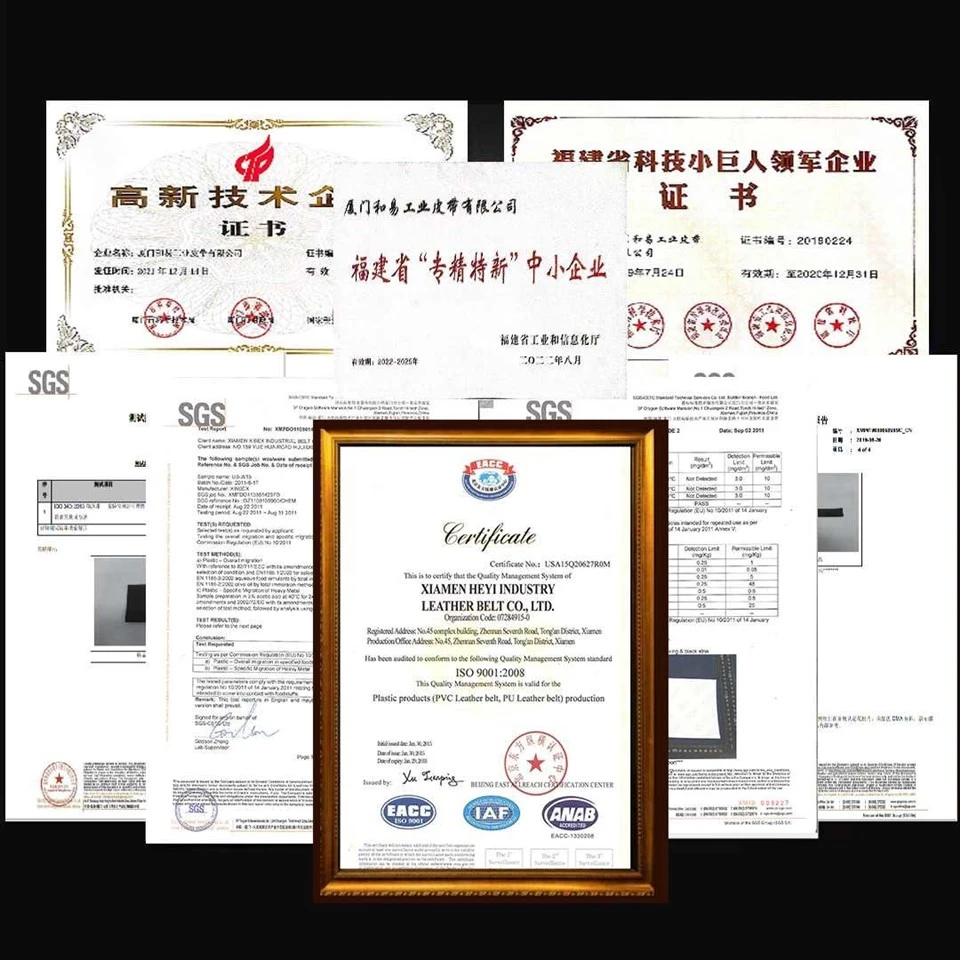

PVC conveyor belts can be reinforced with textile fabrics or steel cords to enhance their strength and durability. Textile-reinforced PVC belts are commonly used in light to medium-duty applications, while steel cord-reinforced PVC belts are used in heavy-duty applications.
PU (Polyurethane)
PU is a high-performance plastic material that is known for its excellent abrasion resistance, flexibility, and chemical resistance. It is commonly used in the manufacturing of conveyor belts for the food processing, packaging, and automotive industries.
PU conveyor belts can be formulated to have different properties, such as food-grade, anti-static, or oil-resistant. Food-grade PU belts are used in the food processing industry, where they must meet strict hygiene and safety standards. Anti-static PU belts are used in applications where static electricity can cause problems, such as in the electronics industry. Oil-resistant PU belts are used in applications where exposure to oil or grease is a concern, such as in the automotive industry.
PU conveyor belts can be reinforced with various materials, such as textile fabrics or steel cords, to enhance their strength and durability. Textile-reinforced PU belts are commonly used in light to medium-duty applications, while steel cord-reinforced PU belts are used in heavy-duty applications.
For example, we offer a Flat White PU Conveyor Belt Food Grade that is specifically designed for the food processing industry. This belt is made of high-quality food-grade PU material, which is resistant to abrasion, chemicals, and bacteria. It is also easy to clean and maintain, making it an ideal choice for use in food processing plants.
Metal
Metal conveyor belts are made of various metals, such as stainless steel, carbon steel, or aluminum. They are known for their high strength, durability, and resistance to heat and corrosion. Metal conveyor belts are commonly used in the automotive, aerospace, and manufacturing industries, where heavy loads and high temperatures are involved.
Stainless steel conveyor belts are the most commonly used type of metal conveyor belts due to their excellent corrosion resistance and hygiene properties. They are commonly used in the food processing, pharmaceutical, and electronics industries, where cleanliness and hygiene are important. Carbon steel conveyor belts are used in heavy-duty applications, such as in the mining and transportation industries, where high strength and durability are required. Aluminum conveyor belts are used in applications where weight is a concern, such as in the aerospace industry.
Metal conveyor belts can be designed in various configurations, such as flat belts, modular belts, or wire mesh belts. Flat metal belts are commonly used in applications where a smooth surface is required, such as in the transportation of flat items. Modular metal belts are made up of individual modules that are connected together, allowing for easy customization and replacement. Wire mesh belts are made of woven wire mesh, which allows for air or liquid to pass through the belt, making them ideal for use in applications such as drying, cooling, or washing.
Fabric
Fabric conveyor belts are made of various fabrics, such as cotton, polyester, or nylon. They are known for their flexibility, low cost, and ease of installation. Fabric conveyor belts are commonly used in the light to medium-duty applications, such as in the packaging, printing, and woodworking industries.
Cotton conveyor belts are the most commonly used type of fabric conveyor belts due to their low cost and availability. They are commonly used in applications where a soft and flexible belt is required, such as in the transportation of delicate items. Polyester and nylon conveyor belts are stronger and more durable than cotton belts, making them suitable for use in medium to heavy-duty applications.
Fabric conveyor belts can be coated with various materials, such as rubber or PVC, to enhance their properties, such as abrasion resistance, chemical resistance, or anti-static. Coated fabric belts are commonly used in applications where the belt needs to have specific properties, such as in the food processing or electronics industries.
Conclusion
In conclusion, conveyor belts can be made of a wide range of materials, each with its own unique properties and ideal use cases. As a conveyor belt supplier, I understand the importance of selecting the right material for the job to ensure optimal performance and longevity. Whether you need a rubber belt for heavy-duty applications, a PVC belt for food processing, a PU belt for high-performance applications, a metal belt for extreme conditions, or a fabric belt for light to medium-duty applications, I can provide you with the right solution.
If you are interested in learning more about our conveyor belt products or have any questions about the materials used in their construction, please feel free to contact us. We would be happy to discuss your specific requirements and provide you with a customized solution. Let's work together to find the perfect conveyor belt for your application.
References
- "Conveyor Belt Handbook" by J. M. McKee
- "Materials Science and Engineering: An Introduction" by William D. Callister Jr. and David G. Rethwisch
- "Plastics Engineering Handbook of the Society of Plastics Engineers" by Charles A. Harper